Forget Graham, the Car Crash Man, Meet Nigel, the Data Man
A speculative anatomy of life with the world’s knowledge under the skin
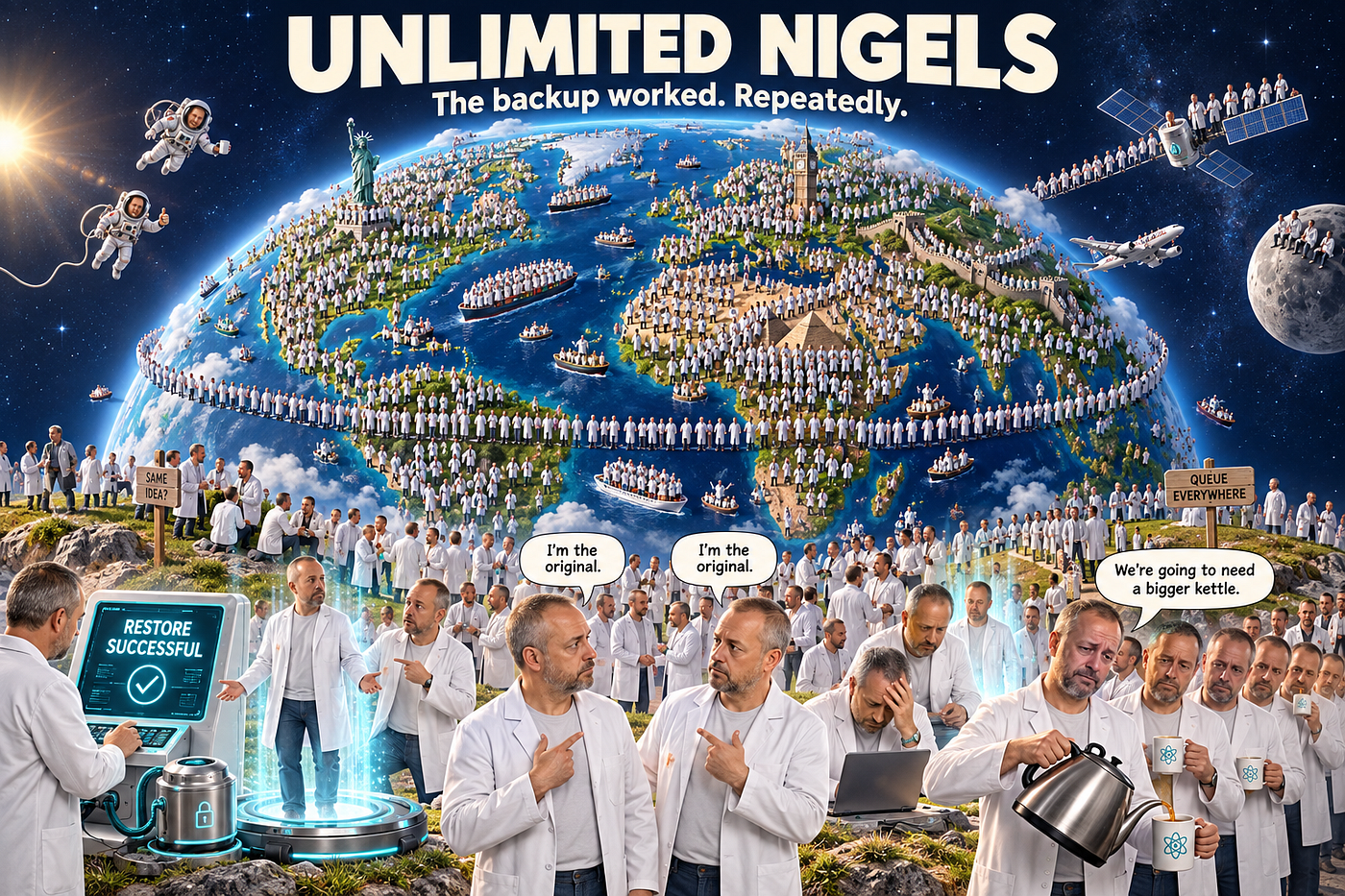 I should have gone with Unlimnited Trevor’s but even I thought that was too much
Graham is difficult to forget. Created for Australia’s Transport Accident Commission by artist Patricia Piccinini, working with trauma surgeon Christian Kenfield and road safety engineer David Logan, he imagines a human body better equipped to withstand a car crash. His enlarged skull, absent neck and cushioned chest make our physical vulnerability visible. Each strange feature has a purpose. [1]
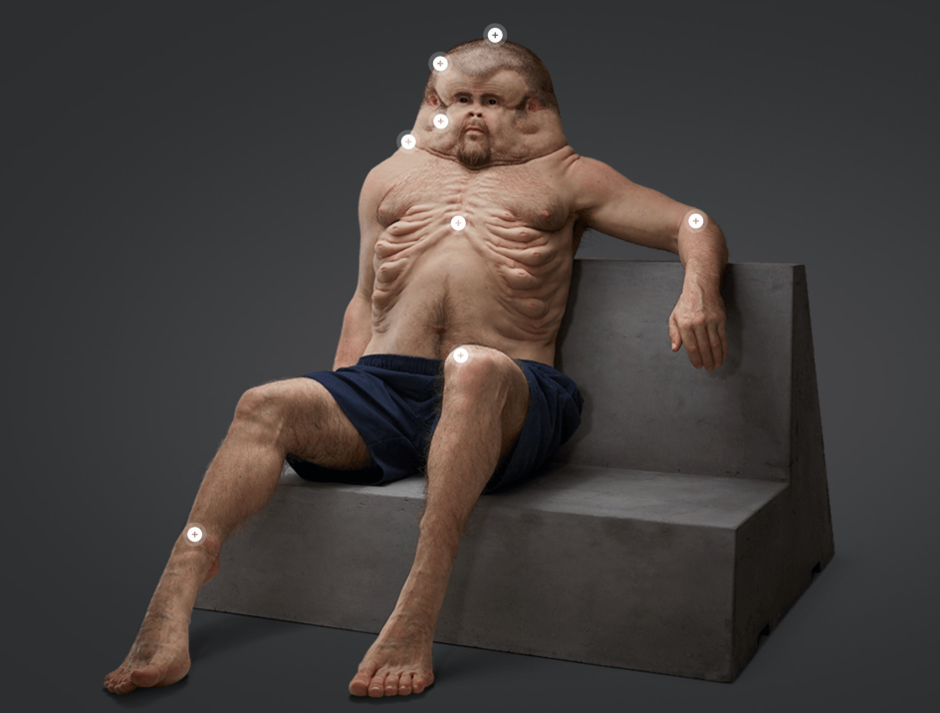 This is Graham, a fantastic research project which can be found at www.meetgraham.com.au
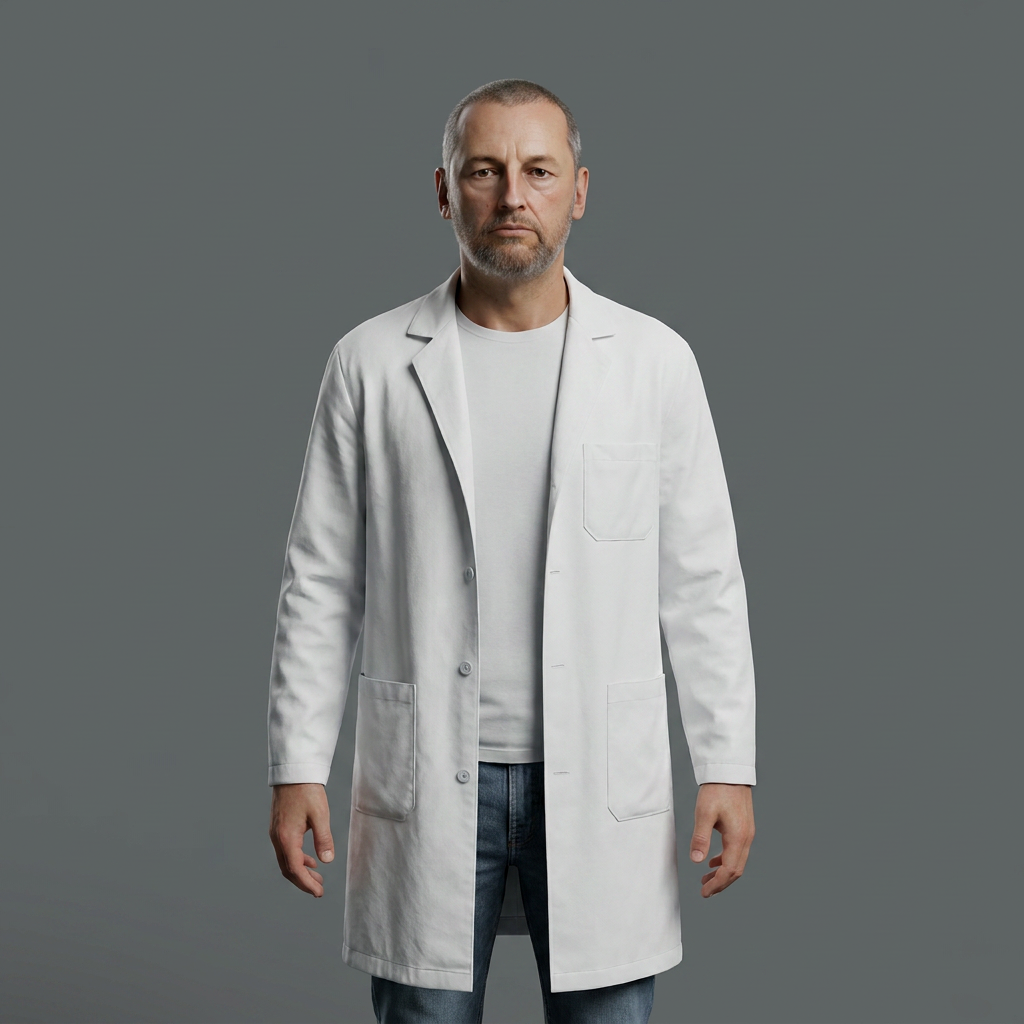
I would like to introduce someone with a different set of problems. Meet Nigel, the Data Man.
 No one will know its actually me, its not like I put myself into every single story.
Nigel lives at a point in the future when the excitement about artificial intelligence has subsided. It has become ordinary infrastructure. People still complain about it, naturally, but mostly because an update has arrived at an inconvenient moment.
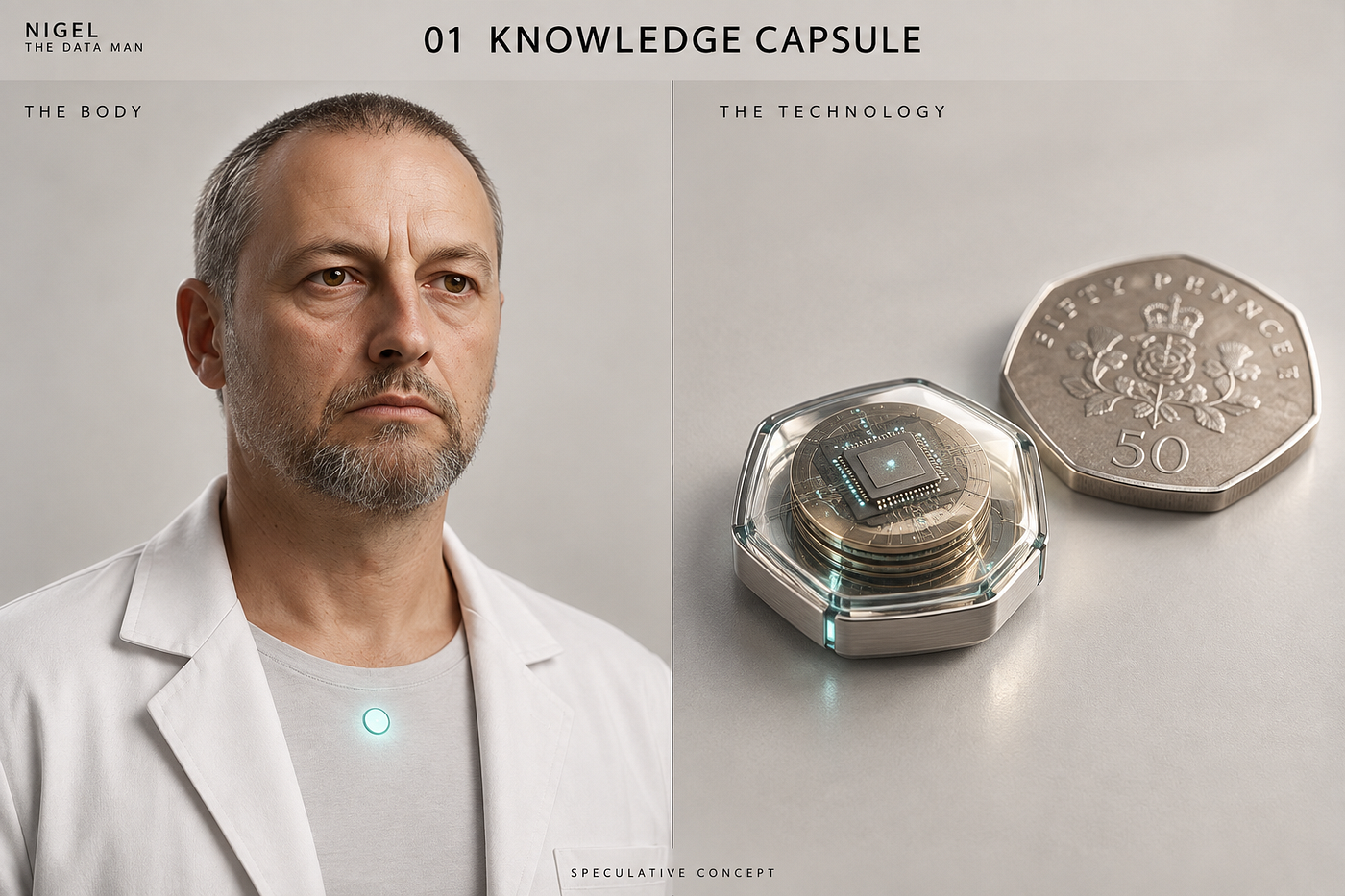
Every human receives a device roughly the size of a 50p coin. It contains all publicly available human knowledge, the index needed to search it and powerful local language models to help make sense of it. New material arrives daily. Between updates, the system works independently of the network.
That is the premise of our thought experiment. Nigel’s alterations are imagined engineering, rather than a prediction that natural selection will eventually produce a USB socket. His body gives us a way to examine what this future would demand of us.
This is a little personal. I already live with a deep brain stimulator, implanted to help manage chronic cluster headaches after other treatments had failed. I wrote about the experience in The Six Billion Dollar Man, including the rather unusual business of having to recharge myself. [6]
That implant is a medical treatment. Nigel’s storage, replaceable thinking modules and mental backups remain imagined technologies. But the experience of depending on something electronic inside the body is already part of my everyday life.
I’m already part way there. I just need an upgrade or three.
At first glance, he looks reassuringly ordinary. Then you notice the service seam above his ear, the optical connection in his wrist and the faint amber colouring spreading across his forearms. Nigel is nearly full. He has been meaning to sort out his photographs.
Start with the small capsule beneath his breastbone. Inside it sits the public archive, separate from his private records. The resemblance to Douglas Adams’s The Hitchhiker’s Guide to the Galaxy is deliberate: a portable guide to an impossibly large world, available whenever its owner needs an explanation. Nigel has simply dispensed with the inconvenience of carrying the book.
 The Beginning…
There is real science behind the attraction of very small storage. In 2017, the DNA Fountain researchers reported successful retrieval at a density of 215 petabytes per gram of DNA, using an experiment that stored about 2.14 megabytes. The distinction matters. They demonstrated remarkable density in the storage material; they did not build a device containing 215 petabytes, a fast reader and a computer in one gram. [2]
Multiplying that density by the weight of a coin does not tell us what fits inside a working implant. Nigel also needs machinery to read and write the data, error correction, processing, working memory, power and protection from damage. “The entire public internet” would need a definition, too: a dated collection of accessible material, with decisions about duplication, changing pages and media. Public availability alone would not settle permission to redistribute it.
Nigel’s coin therefore represents several breakthroughs at once. We can imagine the destination, but we cannot responsibly put a delivery date or a consumer price on it. A prediction of “twenty or thirty years” would be a guess dressed as a product roadmap.
The independence is easier to recognise. Language models can already run locally on suitable computers. The ambitious leap is giving everyone vastly greater capability in a tiny, affordable device that can operate safely inside a body. [3]
Nigel could ask a question without sending it to a remote AI service. He could work through an idea on a train with no signal, consult his archive during an outage or learn without somebody else keeping a record of every question. Local operation would help protect those conversations, although compromised software, physical access and careless sharing would still matter.
His archive and his AI would have distinct jobs. A model’s learned parameters are not a faithful filing cabinet containing every source. Nigel would need the underlying documents and an index, with the model retrieving material and explaining it. Research on retrieval-augmented generation already explores this combination. [4]
This brings us to his eyes. Nigel’s visual display can show where an answer came from, when the source was updated and whether other sources disagree. He can inspect the evidence before acting. He has access to humanity’s accumulated mistakes as well as its discoveries; enormous capacity has not relieved him of the need for judgement.
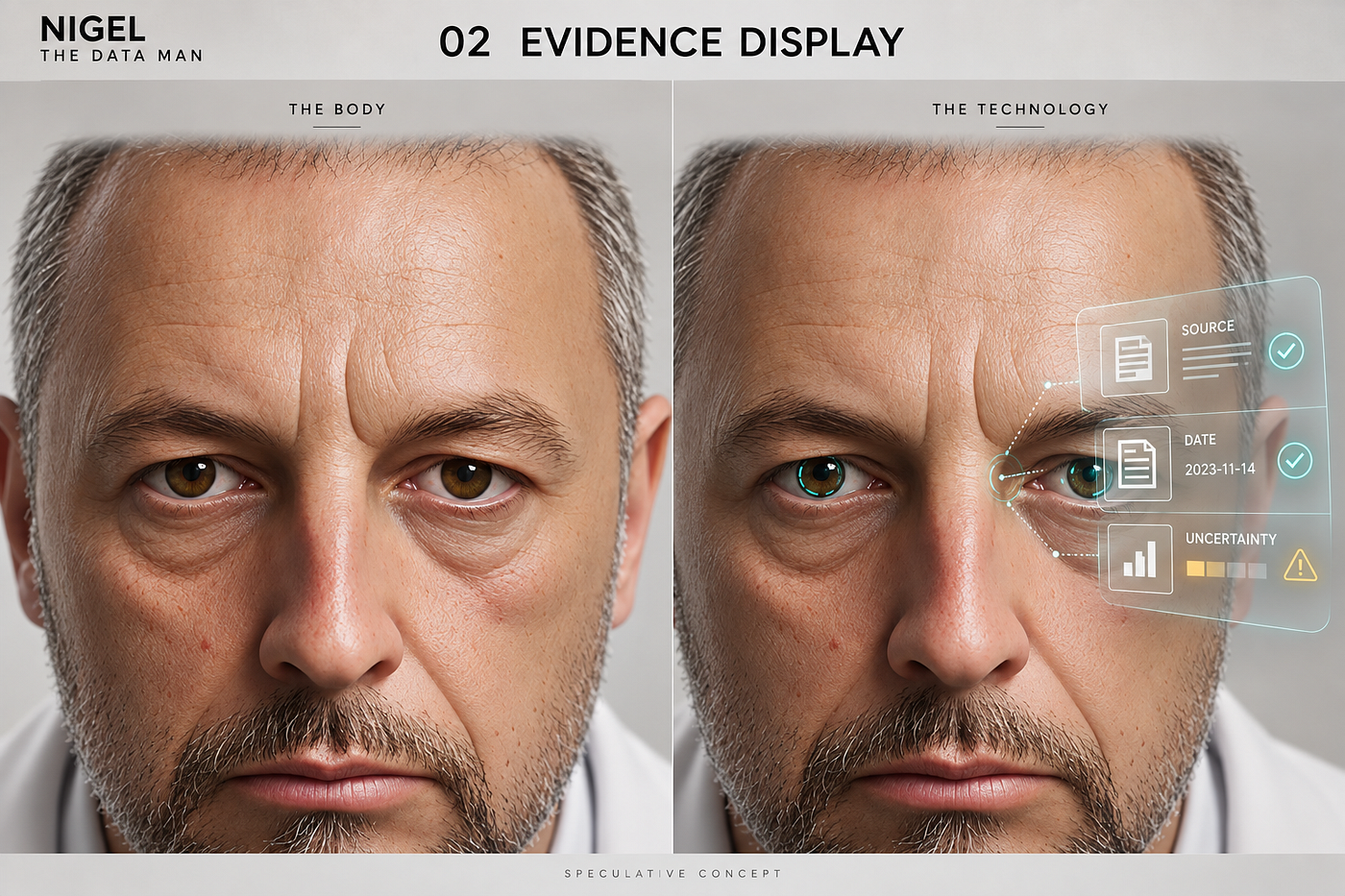
His system also needs to say “I don’t know”. Installing the internet in a person should not mean installing the internet’s confidence.
Follow his arm down to the wrist. Beneath a protective flap is a high-speed optical interface. When Nigel rests his hand on a compatible surface, it can deliver updates and, with his permission, exchange selected files. Ordinary contact with another person does not grant access. A handshake remains a handshake.
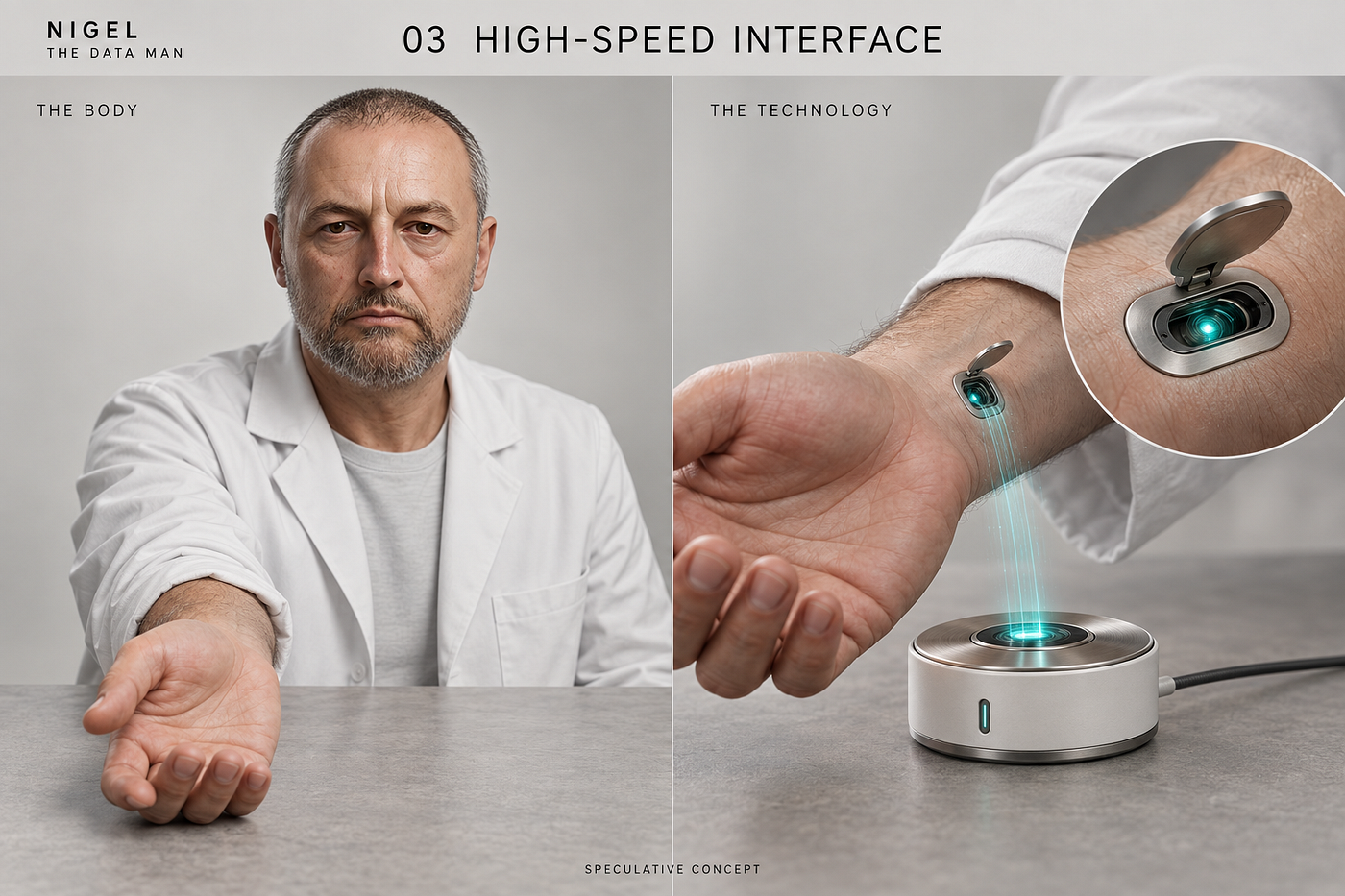
The port is there because storage capacity and transfer speed solve different problems. To illustrate the scale, imagine a daily update of one petabyte. At one terabyte per second, transferring it would take 16 minutes and 40 seconds. At one gigabit per second, the same transfer would take about 93 days. These calculations use decimal units and ignore overheads; the update size is an illustration, not an estimate of the internet’s daily growth.
Even Nigel cannot finish Tuesday’s update if Monday’s takes three months. His system would receive changed material and revised index entries, while common updates could be distributed through shared local hubs or broadcast channels. Model upgrades could arrive separately. Adding a new document should not require retraining or replacing the entire model, and a change to model weights would not necessarily make a small download.
“Offline” would mean independent between updates. Fresh information must still arrive through some connection or physical delivery. Nigel could decline it, but his guide would then need to display its age. Yesterday’s knowledge can be useful, provided nobody mistakes it for today’s.
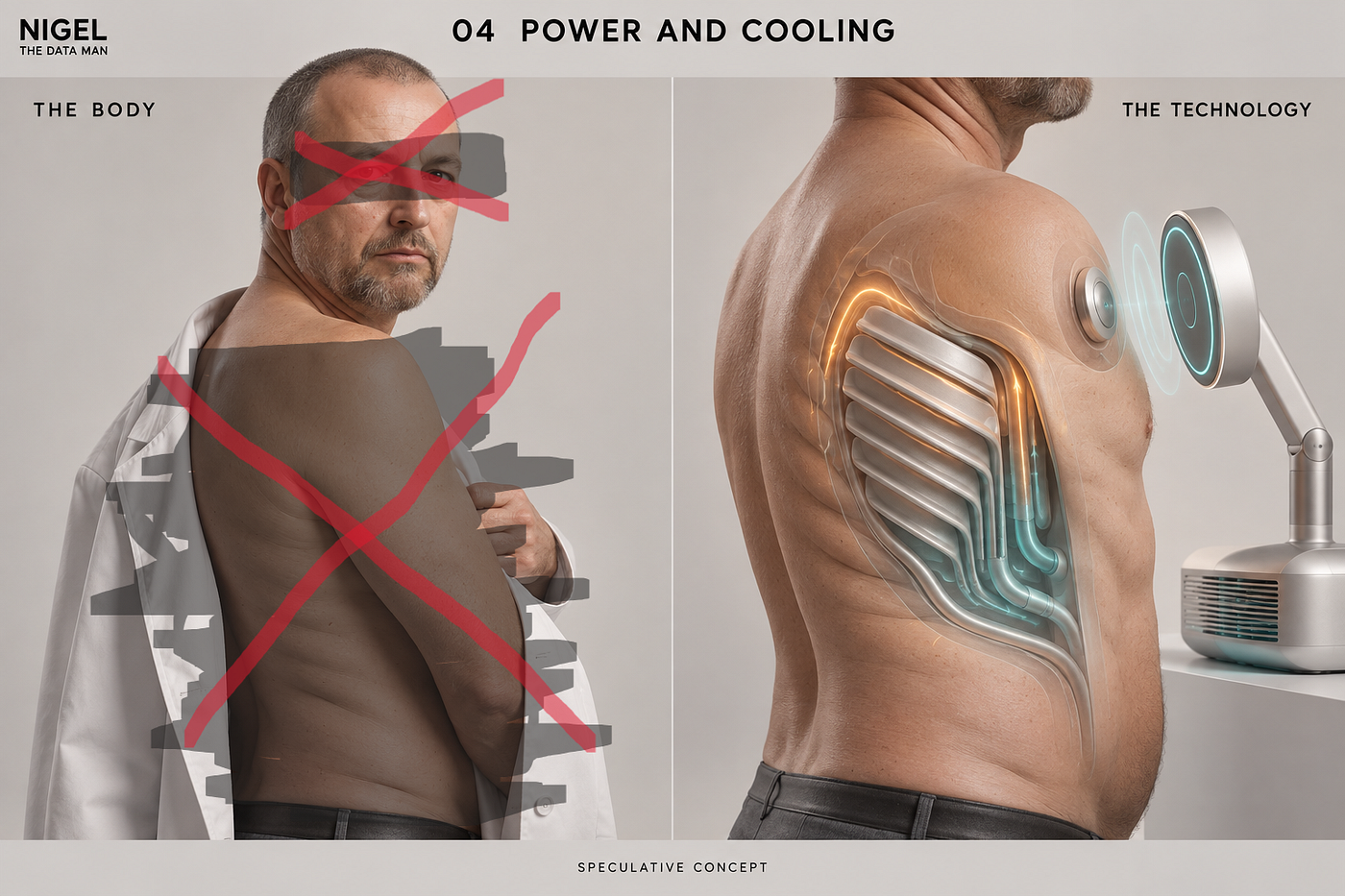
The shallow folds around his ribs and upper back are the cooling system. Reading a huge archive and running powerful models require energy, and the heat must go somewhere. Nigel has an external charging connection and a strict limit on how warm his internal components may become. For difficult work, he might still sit at a powered desk that supplies extra cooling. The coin has not abolished the rest of the computer.
Move up to the seam above his ear. This is where the idea becomes more unsettling: Nigel has swappable brains.
Initially, these would be replaceable computing modules. He might fit one suited to mathematical work, another to language, or replace a failed processor without disturbing his private archive. The design would need to preserve his personal settings and keep unfamiliar modules away from information they had no reason to access.
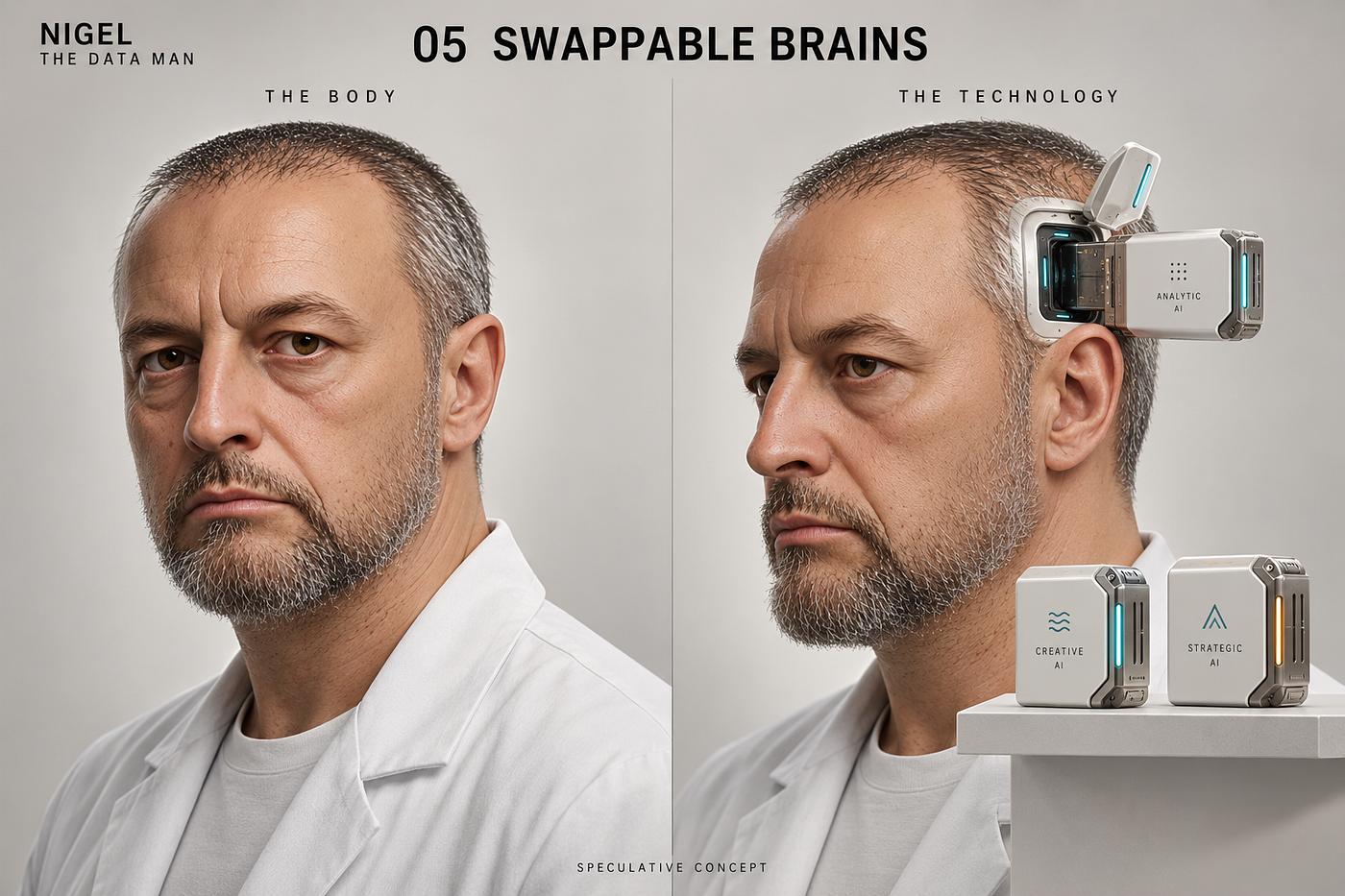
Swapping a biological brain, or transferring the person living in it, is a much greater leap. Calling both operations an upgrade conceals the difficult part. A new processor does not establish that Nigel’s memories, character or conscious experience can be moved with it.
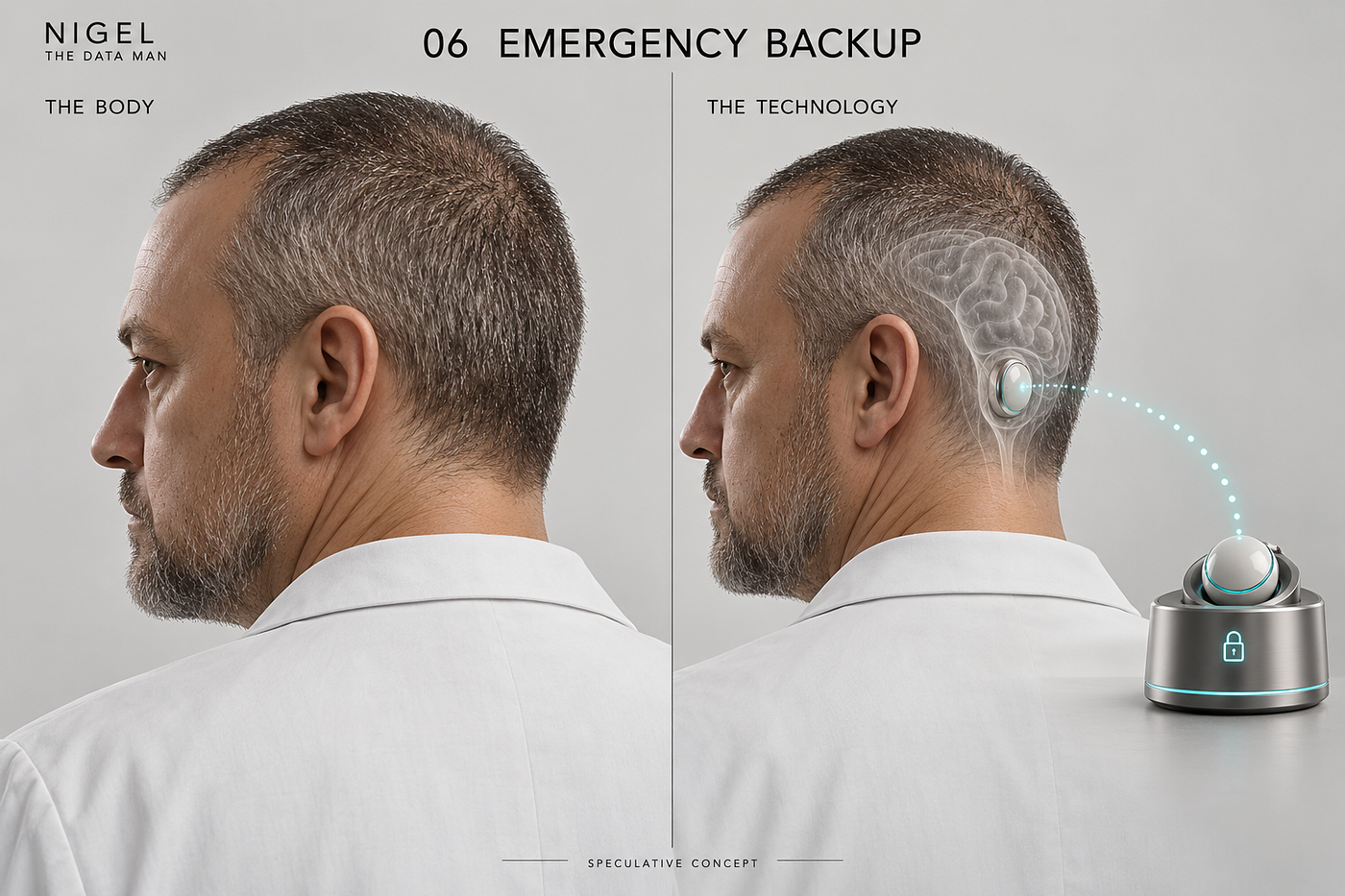
For that possibility, look at the protected compartment near the base of his skull: the emergency backup. In our imagined future, it preserves recoverable records of Nigel’s mental life. An encrypted copy is also held somewhere physically separate. A backup stored only inside Nigel would have an obvious weakness if something happened to Nigel.
We can already preserve someone’s writing, photographs, recorded voice and recollections. Brain mapping is also an active field of research. A complete wiring diagram of an adult female fruit-fly brain was published in 2024, containing 139,255 neurons and more than 50 million chemical synapses. The work has moved beyond the earlier milestones of worms and fly larvae. [5]
A wiring diagram, however, does not by itself establish how to capture and restore a person. We do not yet know everything a faithful reconstruction would have to preserve, or how to read it from a living human brain without destroying what we hope to save. A convincing digital imitation would not prove continuity of consciousness. There is no established timetable for a restorable human mind.
That uncertainty belongs in Nigel’s story. It makes his backup more interesting. Suppose two restored versions remembered the same childhood and both believed they were Nigel. Their shared history would not settle which one, if either, continued the original experience. The familiar language of copying files starts to strain when the files can disagree with you.
Even a less ambitious personal archive would deserve careful design. What happens to the hours since the last backup? Can a corrupted update damage every copy? Who tests recovery? Anyone who has managed important data will recognise the distinction between having a backup and knowing it can be restored. Nigel would have unusually strong reasons to care.
Now return to his skin. An engineered pigment layer shows storage use, synchronisation and faults through adjustable colours and patterns, independently of his natural complexion. As space runs low, amber bands deepen across his forearms. A small display gives the exact figures. For once, “you look a bit overloaded” is a useful diagnosis.
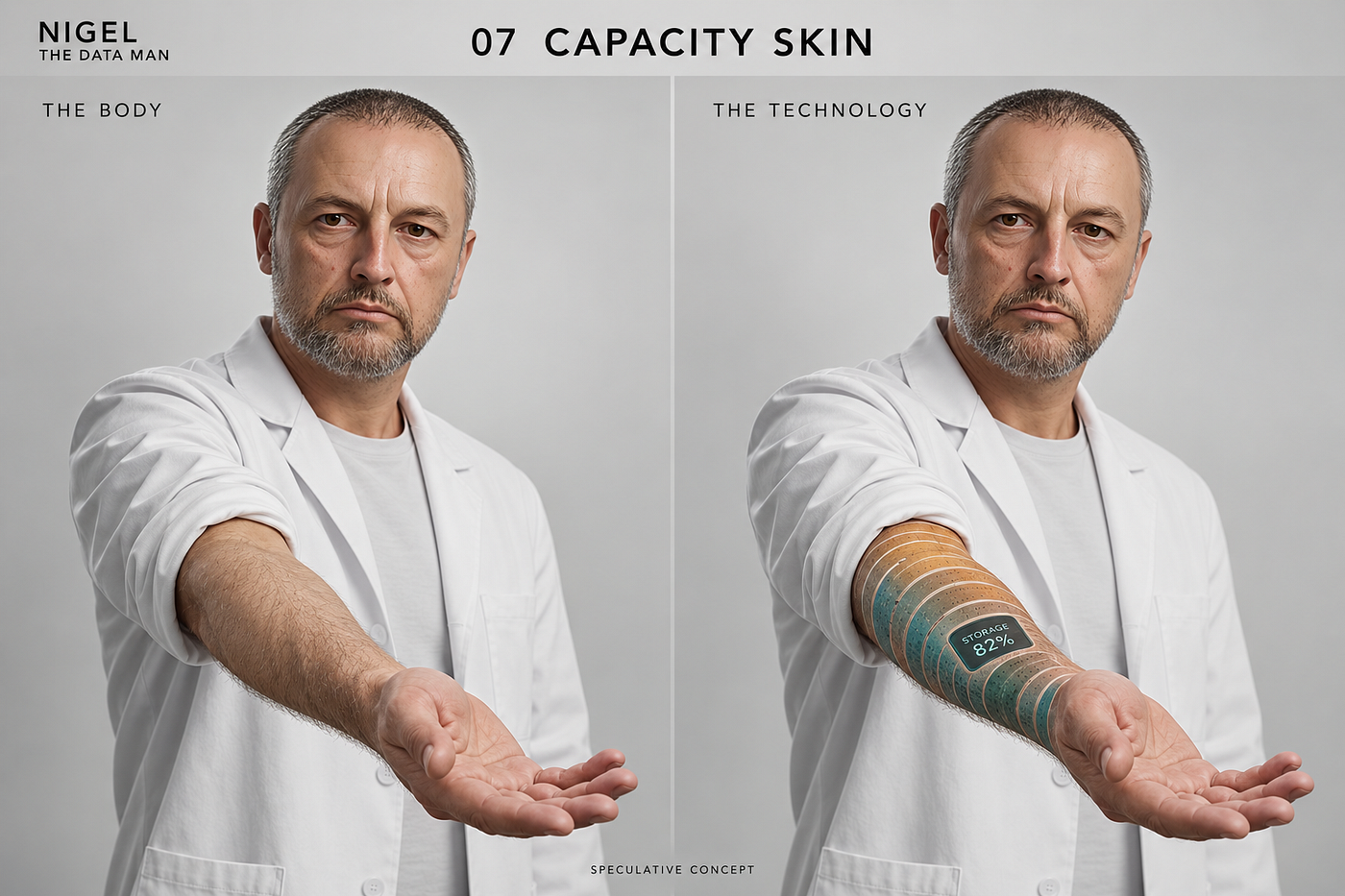
The display can be hidden. A person should not have to announce a technical problem to everyone in the supermarket. The more disturbing version of the display appears when Nigel misses a payment.
Imagine his wrist showing: “Your personal archive will be deleted in 72 hours. Please update your payment method.”
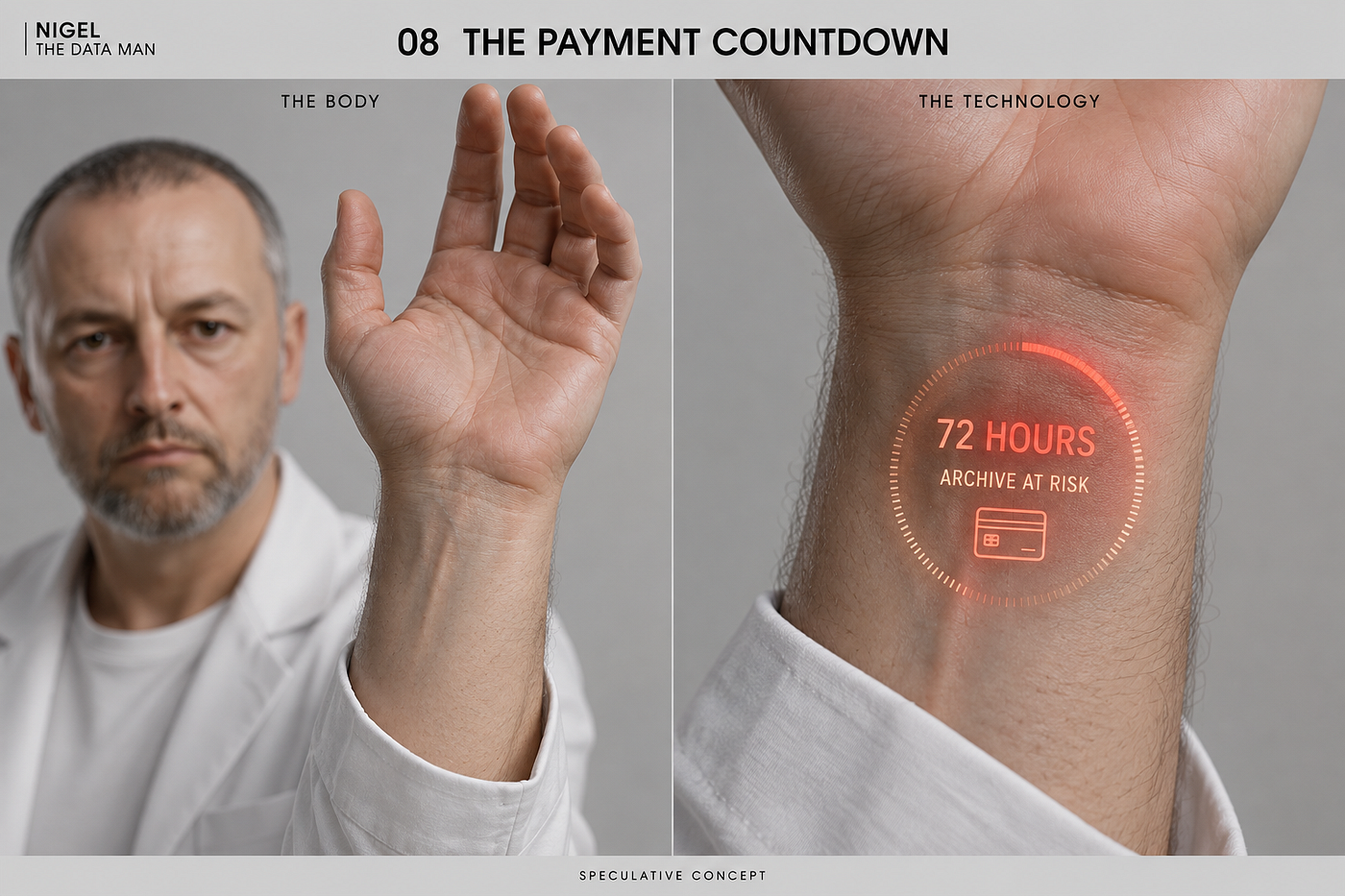
This is a deliberately bleak commercial possibility. The core device might have been issued to everyone, while additional capacity, maintenance or recovery services became subscriptions. A supplier could still impose an expiry condition on locally stored data. It would not need a permanent connection if the restriction had been installed in advance.
Nigel’s red warning skin would expose a failure of ownership. If missing a bill could erase a person’s memories, whoever controlled the account would hold extraordinary power over that person. Giving everyone the hardware would have achieved very little if continued access to their own life remained conditional.
I would give Nigel permanent control of his personal records, with usable export formats, independent recovery and a baseline service that survives financial difficulty. Optional services could stop when a subscription ends. His own memories should remain accessible. The hardware must distinguish those cases before somebody decides that deletion is a convenient billing feature.
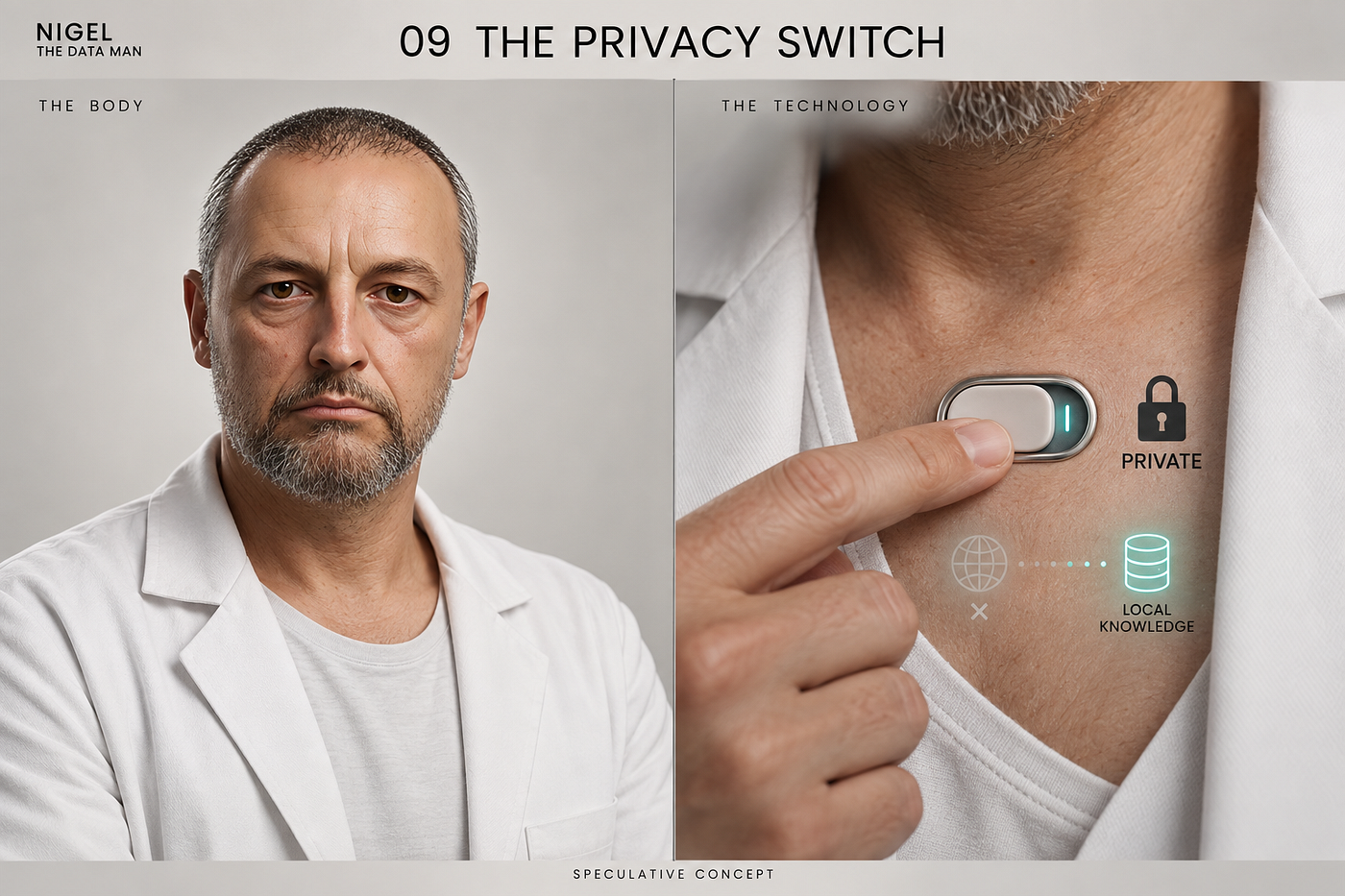
There is one more control on his chest: a physical privacy switch. Nigel chooses what may leave the device. He can share a piece of public knowledge without sharing his reason for looking it up, and send a file without handing over his entire history. Emergency access would be limited to information he had chosen in advance, rather than treating illness as permission to inspect everything.
He would also need some ability to let experiences fade. A permanent archive of every conversation could burden the person carrying it and intrude on everyone they met. Nigel’s improved memory must leave room for other people’s consent, and for his own decision that some moments do not need to become records.
For me, the appeal of Nigel reaches beyond convenience. Even a life lasting seventy to a hundred years can feel short when so much of it is spent earning enough to live, dealing with illness or worrying about what comes next. By the time we have accumulated experience we might use well, there may be less freedom and time to use it than we had hoped.
A longer life would not automatically produce a wiser person, and a short life can have an enormous impact. Still, I find the loss of so much hard-won experience troubling. Preserving more of it could help people teach, create and contribute for longer, even if preserving the conscious person remains beyond us.
Nigel would need time to use his knowledge. If an implant simply made him available for more work, more monitoring and more demands, he might know everything and have no afternoon to himself.
Graham’s imagined anatomy makes us look again at the roads and vehicles around him. Nigel invites the same scrutiny of the systems we are building around information. His backup compartment, cooling folds and warning skin make their requirements visible. They also give us something concrete to challenge before those requirements become ordinary.
Perhaps Nigel’s most valuable feature is the small switch on his chest. He presses it, closes the connection and goes outside. The world’s knowledge can wait until he has finished his tea.
Nigel’s interactive body tour
These are imagined features, not a medical or engineering specification. Having said that the most often asked question about my own brain implant is “How do you charge it?”
Breastbone / The knowledge capsule / A 50p-sized home for the public archive, search index and local models. Nigel carries the library; he still has to judge the answers.
Eyes / The evidence display / See the source, its date and any disagreement before acting. Unlimited storage does not make every answer true.
Wrist /The high-speed interface / Receive updates or share selected files through a protected optical port. Every exchange needs permission. Handshakes remain social.
Its a good job no one realises that I’m at actually Nigel
Ribs and upper back / Power and cooling / Extra cooling surfaces manage the heat of computation. Heavy work may require a powered desk. Thinking has an energy bill.
Above the ear / Swappable brains / Replace specialist computing modules while protecting the private archive. Transferring a biological mind remains a much larger, unresolved idea.
Base of the skull / The emergency backup / Preserve recoverable personal records, with another copy stored elsewhere. A restored archive would not by itself prove that the person survived.
Forearms / The capacity display / An adjustable pigment layer shows storage use and system health. Colours are paired with patterns and readable numbers. Nigel can hide the display.
Inner wrist / The payment countdown / A fictional warning counts down to deletion after a missed bill. This deliberately bad design asks who really owns Nigel’s memories.
Chest / The privacy switch / Nigel controls what leaves his device and can close the connection. Access to public knowledge does not require access to his private life.
Research behind the article
Sources support the present-day science and Graham’s background. Nigel’s anatomy, service arrangements and dialogue are speculative. No date is claimed for a practical coin-sized knowledge implant or a restorable human mind.
1. Graham — Science Gallery Melbourne
Graham’s creators, commission and imagined protective anatomy.
2. Erlich and Zielinski — DNA Fountain enables a robust and efficient storage architecture
Science, 2017. The experiment encoded about 2.14 MB and reported a physical DNA storage density of 215 PB per gram. The density excludes a complete reader, writer and computer.
3. Ollama — FAQ
Documents local model operation and the option to disable cloud features. Local execution is already possible; Nigel’s imagined capabilities and form factor are speculative.
4. Lewis and colleagues — Retrieval-Augmented Generation for Knowledge-Intensive NLP Tasks
2020. Explores combining a language model with an explicit, retrievable knowledge store.
5. Dorkenwald and colleagues — Neuronal wiring diagram of an adult brain
Nature, 2024. The adult female fruit-fly brain reconstruction contains 139,255 neurons and more than 50 million chemical synapses. It is a structural map, not a demonstrated backup of a conscious individual.
6. Trevor Dwyer — The Six Billion Dollar Man
Medium, 5 September 2026. The author’s account of receiving a deep brain stimulator for chronic cluster headaches and living with the implanted device.
Transfer calculations use decimal units: 1 PB = 1,000 TB; 1 byte = 8 bits. At 1 TB/s, 1 PB takes 1,000 seconds. At 1 Gbit/s, it takes 8,000,000 seconds, or approximately 92.6 days. These are ideal transfer times without protocol overhead, contention or processing delays.
Footnote
Due to a glitch in the Brain Backup & Restore program and having the entire world’s information available to him…
One Nigel became two. Two became a support ticket. By lunchtime, the queue for tea had reached orbit.
Every Nigel insisted he was the original.
Technical support recommended restoring from backup.
Unfortunately, technical support was also Nigel.
Feels a bit like Rimmerworld
If you enjoyed a little bit of Nigel naked then please give it a thunderous round of Claps, if not and you want the real thing, I’m afraid it will require hitting the Clap button as well.