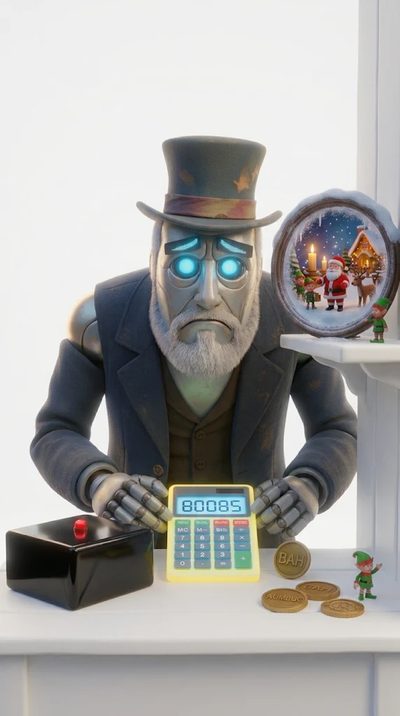
Bah, Hum-bug! A Christmas Cartoon Rendered by SQL Server
The AI Scrooge story in seven scenes, three minutes and about 2,100 frames, every one of them drawn by a stored procedure.
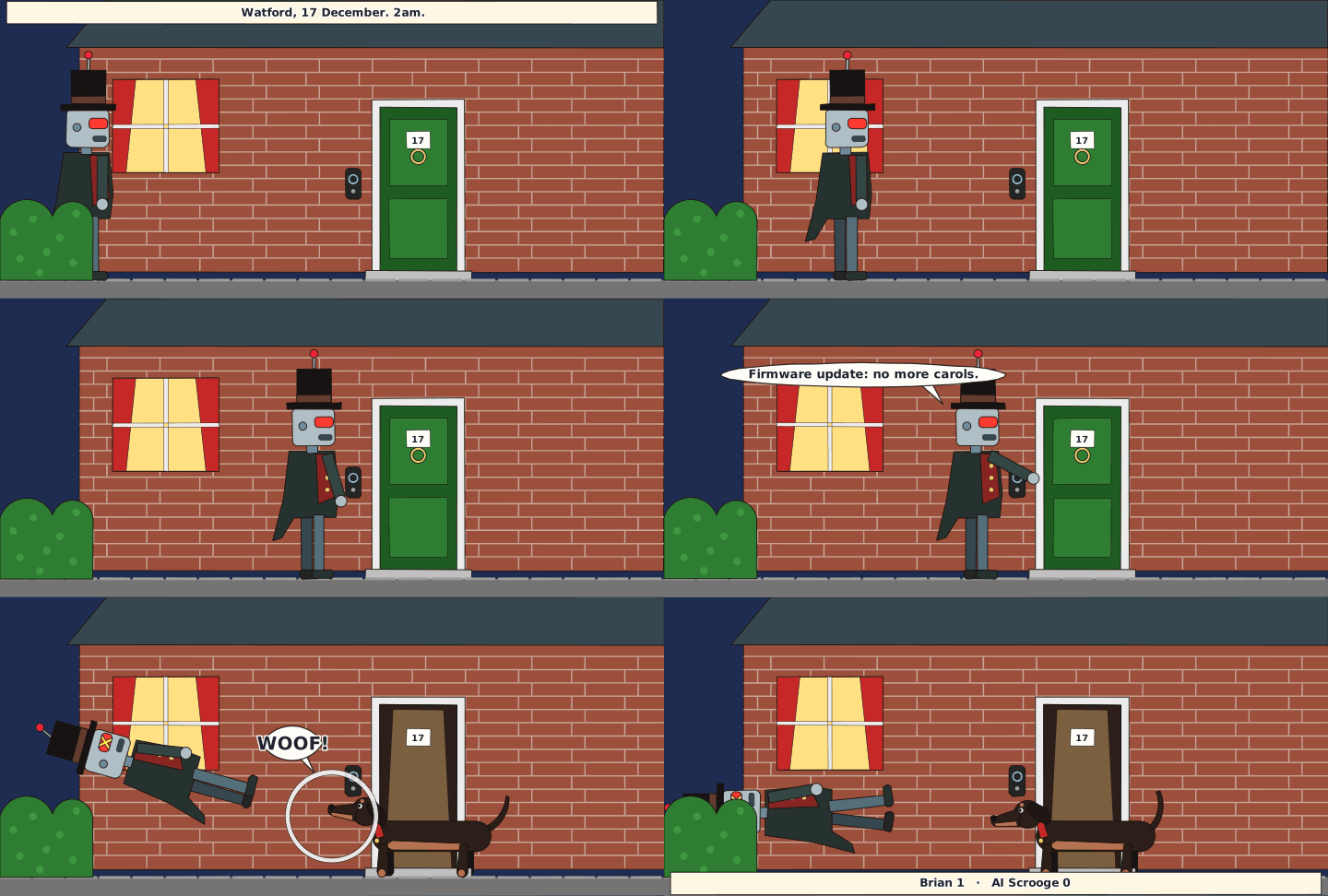 Watford, 2am. The smart doorbell picks up a 120 dB dachshund.
Watch all seven scenes, with the SQL behind every frame →
A few weeks ago I made a twenty-second cartoon inside SQL Server. Brian, my dachshund, chases a ball across a park. It was a test, really: could a database do the kind of card cut-out animation I grew up with on 1970s children’s TV?
It could. So the obvious next question was whether it could tell a whole story.
I already had one. The AI Scrooge Tracker follows E.B.E.N.E.Z.E.R. through December: his schemes, his three ghosts, the Christmas Eve chase and Boxing Day in Watford. The tracker tells it a day at a time. I wanted to see it all in one go.
Seven scenes, not twenty-seven
The tracker has a scheme for every day of December. Animating all of them would have made a twenty-minute film nobody would sit through, me included. So I picked the moments that carry the story:
- Slough, midnight. He boots up. Marley’s old server warns him about the spirits. He marks it as spam.
- December’s schemes. Drones instead of deer, one-star reviews for the Edinburgh Christmas market, and an attempt to cancel the sunrise at Stonehenge.
- The smart doorbell. A firmware update to stop the carols. Then the door opens.
- Three visitors. A beige 1995 PC, a wardrobe-sized smart speaker, and a loading spinner that never says a word.
- The chase. Santa and AI Scrooge go round the North Pole all night, forty minutes apart.
- What day is it? A prize turkey, delivered by drone.
- Boxing Day. A present for Brian. Brian prefers the box.
About three minutes. Short enough to watch, long enough to land the joke.
Everything is a row
Every character is a puppet made of geometry shapes, each pinned to its parent at a pivot, like card cut-outs with drawing pins. AI Scrooge is twenty-two parts. His hat carries the antenna, the antenna carries the bulb, and when he gets knocked off his feet all of it goes with him.
Every movement is a row in a keyframe table: this part, this channel, this frame, this value. The renderer is a stored procedure. It works out where everything is for every frame, moves the shapes, and adds a little felt-tip wobble so the lines shimmer the way hand-drawn cartoons used to.
The part I like most is that the ending is just data. One of the demos copies the chase scene, changes a single number in AI Scrooge’s keyframes and renders it again. This time he gets a tailwind. I’m not saying what happens.
Show the SQL
When I put the scenes on this site I wanted people to see what was going on under the hood, not just take my word for it. So each scene has a Show the SQL checkbox. Tick it and a panel opens beside the animation, showing the render call for the frame on screen, the keyframes that are moving things at that moment, and a row of the geometry that came out.
I’d thought about laying the code over the picture. But too much happens on the right-hand side of the frame: Marley, the ghosts, the speaker. So the code sits next to it instead.
Made with Claude
Like the tracker, this was a joint effort with Claude. I came up with the scenes, the jokes I’m proudest of and the dog. Claude drew the puppets in WKT, wrote the keyframes, and built a Python copy of the renderer so it could watch the film without a SQL Server to hand. Then I ran the real thing on mine, and every scene came back.
Building a cartoon about an AI villain with an AI is the same irony as last time. I’ve stopped worrying about it.
Watch it
All seven scenes, with the SQL →
Track AI Scrooge through December →
Bah, hum-bug.
Responses
Comment with a free GitHub account, or use the form below to send Trevor a private note.